Glitch Works XT-IDE Rev 4 — 8-Bit ISA IDE Controller
The Glitch Works XT-IDE rev 4 is an open-source 8-bit ISA IDE controller board that enables the use of modern 16-bit IDE devices (CompactFlash adapters, DOM modules, hard drives) on vintage IBM PC/XT, AT, and compatible systems. Designed in KiCad and licensed under GNU GPL v3.0, the rev 4 improves on the rev 3 with better silkscreen, larger jumper pads, corrected latch read/write timing, additional Slot 8 Support test points, and consistent parts numbering for easier kit assembly. When paired with the XTID
- Bus Interface
- 8-bit ISA (fits any PC/XT/AT 8-bit slot)
- Storage Media
- IDE/ATA — CompactFlash via adapter, DOM, or standard IDE hard drive
- Design Tool
- KiCad (fully open-source EDA)
- License
- GNU GPL v3.0
- PCB
- 2-layer, ISA form factor, through-hole components
- DIP Switch Banks
- 2x CTS 208-8 (8-position each) for address configuration
- EEPROM
- AT28C64B (8KB, 28-pin DIP) — in-system programmable
- Bus Transceivers
- 2x 74LS245 octal bidirectional transceivers
- Latches
- 2x 74F573 octal transparent latches
- Address Decoders
- 2x 74LS688 8-bit magnitude comparators
- Logic ICs
- 74LS138 3-to-8 decoder, 2x 74LS04 hex inverter, 74LS32 quad OR gate
- Pull-up Networks
- 2x 10Kx9 SIP resistor networks (RP1, RP2)
- Bypass Capacitors
- 11x 0.1uF axial ceramic + 1x 100uF 6.3V electrolytic
- Activity LED
- HP HLMP-3507 with 470R current limiting resistors
- BIOS
- XTIDE Universal BIOS — GPLv2, supports up to 4 IDE controllers
- Revision
- Rev 4 (2017) — improved timing, silkscreen, and Slot 8 test points

Multi-I/O Serial/Parallel Cards - Engineering Application
COM/LPT/FDC multi-function ISA cards configured for deterministic IRQ and DMA behavior in restoration and industrial control systems.
- Interfaces
- COM1-COM4, LPT1-LPT3, optional game port and floppy
- IRQ Mapping
- 2, 3, 4, 5, 7 selectable profiles
- Address Ranges
- 3F8h/2F8h/3E8h/2E8h and custom map options
- UART Coverage
- 8250, 16450, 16550A compatibility paths
- Tooling
- Loopback and parity stress diagnostics
- Deployment
- Field profile templates for mixed adapter stacks
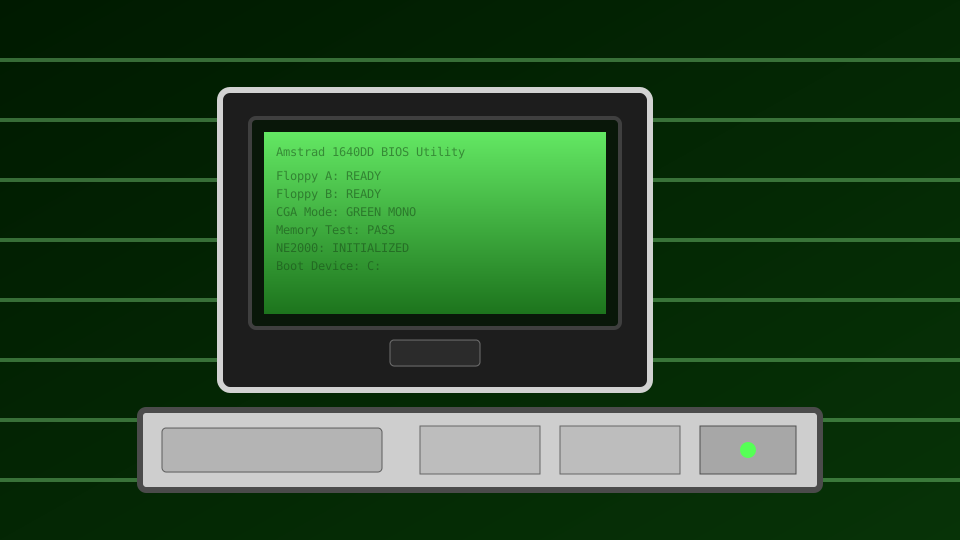
Amstrad PC1640DD — Dual Floppy Desktop System
The Amstrad PC1640 was the successor to the hugely popular PC1512, launched in 1987 with 640KB RAM and an EGA-compatible graphics chipset from Paradise Systems integrated on the motherboard. The 1640DD variant shipped with two 360KB 5.25-inch floppy disk drives. Also marketed as the PC6400 in the United States and sold under the Schneider brand in Germany, it was one of the most successful IBM PC compatibles in Europe and helped open the consumer PC market.
- CPU
- Intel 8086 @ 8 MHz
- Co-processor Socket
- Intel 8087 math co-processor (optional)
- RAM
- 640 KB (on-board)
- Storage
- Dual 360 KB 5.25-inch floppy disk drives (DD model)
- Graphics
- EGA-compatible (Paradise Systems chipset), CGA and Hercules modes supported
- Display
- Colour (ECD) or monochrome monitor; ECD model supports full EGA modes
- Sound
- PC speaker with physical volume control
- Expansion
- Three full-length 8-bit PC/XT ISA expansion slots, supports optional VGA board
- I/O Ports
- RS-232C serial, Centronics parallel, light pen connector
- Input Devices
- Full QWERTY keyboard with Atari joystick port, two-button Amstrad mouse
- Dimensions
- 372 x 284 x 135 mm
- Weight
- 7.75 kg (DD model)
- Power Supply
- Integrated into monitor housing
- Operating System
- MS-DOS 3.2, Digital Research DOS Plus (CP/M compatible)
- Bundled Software
- GEM Desktop, GEM Paint, Locomotive BASIC 2
- Manufacturer
- Amstrad plc (Brentwood, Essex, UK)
- Released
- 1987
- Also Known As
- Schneider PC1640, Sinclair PC500, PC6400 (US)